Too many arrow-switches spoil the balance
Previous  Top 

Too many arrow-switches spoil the balance.  
 
by Ross Moore, Sydney, Australia  

The currently recommended systems of "arrow-switching" to improve the fairness of unbalanced 3/4-Howell, Scrambled Mitchell and similar movements in which pairs do not play every other are based upon an inappropriate criterion, so are invalid. A better criterion leads to fairer movements, which in many cases are also easier to implement. This criterion is applicable to all Duplicate Bridge movements, is closely related to matchpoint scoring, and for complete Howell movements is equivalent to the usual comparison criterion. Failure to meet a pair head-to-head is compensated by having more comparisons in the same direction. A. head-to-head encounter has a greater effect on the score, so fewer comparisons are required for overall fairness. As a "rule-of-thumb", arrow-switching in a single round is best for Scrambled Mitchell movements of up to 11 rounds, while two arrow-switches suffice for up to 18 rounds.


In considering the fairness of Howell movements the concept of comparisons has been well-recognized since the work of Ach & Kennedy [1, 7] in the 1930s. One counts the number of times that each partnership plays boards in the same direction as each other partnership, thereby allowing a direct comparison of the scores obtained. The movement is said to be completely balanced when these are the same for every pair of partner-ships. As it is not always possible to achieve this ideal, the term balance is used as a qualitative measure of how closely it is approached. A movement being "more balanced" than another is taken to mean that the movement is a fairer test of ability — it is less subject to correlations between the overall performances of different pairs due to their positions within the movement.

The validity of this use of comparisons as a measure of "fairness" is due to the fact that with Howell movements two other important criteria are met; namely that ...

each partnership plays against each other partnership, for an equal number  
of boards; and  
 
each partnership plays every board within the movement, from one side or other.  

Frequently movements are used in which these criteria are not met; for example 3/4-Howell and Scrambled Mitchell or Bofors-Mitchell movements. Current directors' manuals[2, 5, 8] and the Encyclopaedia of Bridge[3, 4] recognise that these types of movement do not automatically have good balance, but nevertheless recommend a schedule for arrow-switching board-sets in certain rounds in an attempt to improve the comparisons. That these schedules achieve their aims is not in question. It is the notion that balance of the number of comparisons provides an appropriate measure of fairness which is invalid.

For movements in which not every partnership plays each other the measure of comparison must be altered as follows. For two partnerships A and B define the match-point comparison, shortened to MPcomp, by the formula

Mpcomp (A, B) = #(boardsets where A, B sit in the same direction)  
- #(boardsets where A, B sit in opposite directions)  
+ (N - 1) x #(boardsets on which A, B sit as opponents)  

where N is the number of times that each boardset is played, i.e the number of scores on the travelling score-sheets from which the matchpointing is calculated. For a fair movement, it is the numbers MPcomp (A, B) which ideally should be the same for all pairs of partnerships (A, B).

Notice that, provided each partnership plays every board, each boardset contributes to one or other of the three terms in MPcomp (A, B). Furthermore, if every partnerships plays equally often against each other partnership then the 3rd term contributes equally to every possible MPcomp (A, B). When both these criteria are satisfied, as in a complete Howell movement, then having good balance among the matchpoint comparisons is equivalent to having good balance among the usual comparisons.

To understand the above formula, consider how matchpointing is calculated. On each board a partnership scores a matchpoint for each other partnership, sitting the same direction, who they outscore. Thus if A v B at one table and on the same board C v D in corresponding directions at another table, then whichever of A and C scores higher wins the matchpoint. Since B and D score the negative of A and C respectively, then D wins a matchpoint whenever A does; similarly B and C win or lose together. For the purpose of matchpointing this board A and D are effectively team-mates, with B and C teamed-up as opponents. If the board is played a total of N times, there are (N - 1) such comparisons of scores involving A v B at one table with encounters C' v D' at other tables. Thus B opposes A in the comparisons for (N - 1) matchpoints, whereas each partnership sitting in the same direction as A is an opponent for just 1 matchpoint and each other partnership sitting the opposite way is effectively a team-mate.

The formula for MPcomp (A, B) simply counts the difference in the numbers of times A, B are either on opposing sides or are team-mates for matchpointing purposes — hence the name matchpoint comparisons. It is a direct measure of the extent to which two different partnerships in the movement are in competition with each other. It is clear that good balance among matchpoint comparisons is the correct criterion for fairness.

Intuitively one expects to gain a greater advantage by avoiding playing against a strong partnership (for whatever reason) than by simply having fewer comparisons with them. This is manifest in the above formula. The means to counter this, thereby achieving fairness, is to have more comparisons with those opponents which are not met head-to-head, and fewer with those that are.

Standard Formulae.

For the rest of this article the term "comparison" will refer to matchpoint comparison and the "balance" of a movement will be with respect to the matchpoint comparisons. The term "partnership" will be replaced by the more commonly used "pair"; though (A,B) may still refer to a pair of partnerships.

The ideal value for MPcomp (A, B) can be calculated either as the average over all comparisons for a fixed pair A, or by using global properties of the movement:
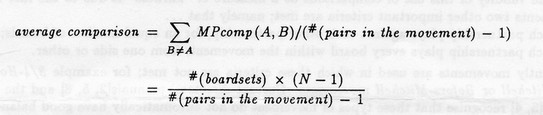
formula1

assuming that every pair plays every board exactly once. As previously, N denotes the number of times each board is played, which is usually once at each table.

Summing all comparisons with a fixed pair A, and for all pairs of partnerships, give useful matchpoint totals:
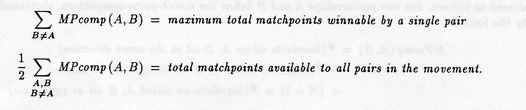
formula2a

Achieving the ideal balance is only possible in a small number of Howell movements. For other movements the following provides a quantitative measure of the lack of balance.
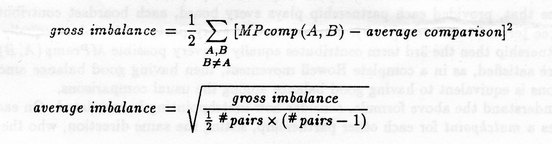
formula3a

This (average) imbalance mimics the definition of statistical standard deviation of the MPcomp (A, B)s for all possible pairs of partnerships. Lower values of the imbalance correspond to fairer movements. An imbalance of 1 or less means an extremely fair movement indeed.


Table 1. Imbalance for Scrambled Mitchell movements — odd number of tables.

Mitchell    McKinnon    Scrambled Mitchell  
number    av.       Farrington    (number of switches)
of tables    comp.    no switch    Rosler    1      2      3       4


5      2.222   2.4845      3.3921      1.6178      3.3921  
7       3.231    3.4896    4.4229    1.0491       3.3086  
               4.6929  
               3.3086  
9       4.235    4.4922    5.6102    1.1647       2.8186       switches in  
               5.6102          3.1348    rounds  
               5.6102                 1, 2, 5  
11       5.238    5.4938    6.4506    1.8748       2.2447  
               6.4506  
               5.7645  
13       6.240    6.4948    7.6277    2.7609       1.7727       3.6582       switches in  
               7.6277                rounds  
               7.4580                1, 2, 6, 9  
15       7.241    7.4955    8.4635    3.7014       1.6327       3.1366  
               7.0008          1.9415  
17       8.242    8.4961    9.4678    4.6647       1.9545       2.5941  
19       9.243    9.4965    10.5534    5.6397       2.5932       2.1360  
21       10.244 10.4969    10.2439    6.6214       3.3842       1.9099  
                           3.4976  
23       11.244 11.4972    13.0336    7.6075       4.2487       2.0457  
25       12.245 12.4974    13.7893    8.5965       5.1529       2.5114    2.4456  
                                       (2.3082)  
27       13.245 13.4976    14.6660    9.5875       6.0809       3.1796    2.1623  
                           6.1304          (2.0179)  
29       14.246 14.4978    15.8571    10.5802    7.0245       3.9571    2.1706  
                                       (2.0372)  
31       15.246 15.4979    16.6720    11.5739    7.9788       4.7964    2.4936  
                                       (2.3861)  
33       16.246 16.4980       12.5686    8.9409       5.6732    3.0485  
                           8.9684          (2.9666)  


Mitchell Movements.

The standard Mitchell movement, for an odd number N of tables, has N boardsets each played N times - once at each table. There are 2N pairs, half of which always sit NS, the others sitting EW. The EW pairs move to different tables each round, cycling in one direction while the boardsets cycle in the opposite direction, with NS pairs remaining stationary. Thus each NS pair meets each EW pair exactly once, and everybody plays every board. The comparisons are MPcomp (A, B) = N for pairs sitting the same direction, and Mpcomp(A, B) = 0 when A, B sit in opposite directions. This latter is true since the encounter on a given round contributes N - 1 to the comparison with the opposing pair; but this pair is effectively a team-mate on each of the other N - 1 rounds.

It is usual to treat the pairs sitting in opposite directions independently, as if in separate movements. The comparisons within each sub-movement are then perfectly balanced; however there must be two winners - one for each direction. If a single winner is required this movement is badly unbalanced. The imbalance is close to N/2 but just a little less, with exact value given by:

formula4a
 
For an even number N of tables the movement is structured a little differently. To avoid the moving EW pairs encountering the same boardsets after ½N rounds, there is an extra "relay" table located between tables ½N and ½N + 1 to which boards move, but EW pairs do not. Also, tables 1 and N share their boardset each round. Thus both the boardsets and the moving pairs cycle among N tables, but not the same N tables; each round only N - 1 different boardsets are used, but one is used twice. Overall every pair plays every board exactly once, with each NS pair meeting each EW pair exactly once. The formula for the imbalance is the same as above, only now with N even.
 
Table 2. Imbalance for Scrambled Relay-Mitchell movements — even number of tables.

      Mitchell    McKinnon       Scrambled Mitchells
number av.       Farrington       (number of switches)
of tables   comp.    no switch    Rosler    1      2       3       4


4   1.714    1.9795            1.4846  
                  2.1189  
6    2.727    2.2065    3.8081    1.2856       switches in  
            3.8712    1.5428       rounds 1, N/2  
            3.8398          unless shown  
8    3.733    2.9147    4.9728    1.3888  
            5.2341    1.2893             switches in  
            4.6399                stated rounds.  
10    4.737    3.6224    6.0319    1.9261       2.2674  
            6.0458    1.6684       2.4114  
            4.3630          2.6286  
12    5.739    4.3298    7.0560    2.6900    1.9386    switches in  
            7.0478    2.4176    1.9829    rounds 1,2,5  
            6.9775          2.0119    unless shown  
14    6.741    5.0371    8.1183    3.5518       1.8291 {1,5}  
            7.6402    3.2985       1.7822  
            6.9100          1.8175  
16    7.742    5.7444    9.1192    4.4611       2.1170    2.7588  
                  4.2310    1.9670    2.9889 {1,3,9}  
                        1.8832 {1,9}  
18    8.743    6.4516    10.1177    5.3967       2.6656 {1,6}   2.3409  
                  5.1880       2.4882    2.4882 {1,3,10}  
                        2.3463 {1,10}  
20    9.744    7.1588    11.0818    6.3485       3.3796    2.1711  
                  6.1582       3.0443 {1,11}    2.1378 {1,3,11}  
                              rounds 1,2,6  
22    10.744    7.8660          7.3110       4.1804 {1,7}    2.2796 {1,3,12}  
                  7.1365       3.8585 {1,12}    2.0778  
24    10.244    8.5731          8.2809       5.0422    2.6775    2.7916 {1,2,8,21}  
                  8.1200    4.7332 {1,13}    2.3653    2.9449 {1,2,6,19}  
                              {1,3,13}  
26    12.745    9.2803          9.2562    5.9312 {1,8}    3.2724    2.5252 {1,2,6,9}  
                  9.1070    5.6424 {1,14}    2.9177    2.4964 {1,2,5,18}  
                              {1,3,14}  
28    13.745    9.9874          10.2355       3.9880    2.4606 {1,2,5,16}  
                  10.0966       3.6264    2.3921 {1,2,6,19  
                              {1,3,15}  
30    14.746          10.6946    11.2180          4.7733    2.8132 {1,2,6,9}  
                              {1,3,10}  
                  11.0879       4.4233    2.5360 {1,2,6,9}  
                              {1,3,16}  
32    15.746    11.4017          12.2029       5.6131    3.2267 {1,2,5,12}  
                  12.0807       5.2802    2.9058 {1,2,6,9}  
                              {1,5,18}  


Scrambled Mitchells
.

To obtain a single winner, but retain the simplicity of the mechanics of the Mitchell movement, a small variation is introduced. On a particular round all boardsets are played arrow-switched; that is, the NS pairs and EW pairs swap directions for that round, reverting to their normal positions for subsequent rounds. Since different tables are playing different boardsets, the effect is to alter the comparisons quite dramatically. This arrow-switching may happen on several rounds. The problem is to determine which set of arrow-switchings give the most balanced movements.

Recommended schedules of arrow-switchings — e.g. the so-called Bofors chart — appear in the Encyclopaedia of Bridge[4, p.386], and are reproduced in directors' manuals [2, p.l3],[5, p.35],[8, p.30]. However these are based on consideration only of the Howell-type comparisons; that is, trying to get all pairs sitting the same direction on equal numbers of boardsets. Since not every pair meets every other pair this cannot be valid. For balanced matchpoint comparisons, pairs who do not meet each other should be sitting the same direction on more boardsets. Those that do meet get a large comparison from this encounter, so to compensate they should be sitting in opposite directions more frequently.

The manuals recommend frequent arrow-switching. This is wrong; fewer arrow-switches produce movements with better balance. Table 1 lists the imbalances obtained from different movements. It can be seen that the "recommended" movements have very poor balance. Indeed in almost all cases a lower imbalance is obtained using the straight Mitchell with no arrow-switching at all; yet no serious competition player would accept that as a valid means of comparison.

Much lower imbalance figures are obtained by arrow-switching in few rounds. When only 1 round is arrow-switched it matters not which round this is. For 2 arrow-switches again it does not matter when N is odd, with the following exception. If N is a multiple of 3 then a higher imbalance is produced if the difference in the numbers of the switching rounds is
1/3N or 2/3N than if not.

These results are understood by considering the effect that arrow-switching a single board has on the matchpoint comparisons. If A v B is arrow-switched to become B v A then MPcomp (A, B) is unchanged but MPcomp (A, C) and MPcomp (B, D) are altered by ±2 for all other pairs C and D according to which way they are sitting when they play the arrow-switched board.

When a single complete round is arrow-switched each (stationary) NS pair is switching a different boardset, so that MPcomp (NS, NS') decreases by 4; namely 2 for the set switched by pair NS and another 2 for the set switched by NS'. Similarly each Mpcomp(EW, EW') decreases by 4 to N - 4. On the other hand each MPcomp (NS, EW) increases by 4, except for the pairs playing each other on the arrow-switch round for whom the comparison remains unchanged at 0. All comparisons are known, so the imbalance can be calculated using the formula given below. Furthermore the value of the imbalance is unaffected by which round it is that is arrow-switched, hence the single entry in the 1-switch column of Table 1.

When a second round is arrow-switched the comparisons between stationary pairs decreases further. Now Mpcomp(NS, NS') becomes N - 8 unless NS and NS' switch on the same boardset, in which case it becomes N - 4. Similarly Mpcomp(NS, EW) increases to 8 unless NS and EW both arrow-switch on the same boardset in which case it becomes 4. Normally there are 4 different EW-pairs having arrow-switches on the same two boardsets as a given NS-pair. However when N is a multiple of 3 it is possible for one EW-pair to arrow-switch on both boardsets; this requires the arrow-switch rounds to be separated by
1/3N or 2/3N. Apart from this special case the average imbalance is independent of which two rounds are arrow-switched. Table 1 lists this value, as well as the extra value possible when N is a multiple of 3.

In general, for k arrow-switch rounds MPcomp(NS, NS') and MPcomp (EW, EW') may take values N - 4k and N - 4k + 4, while Mpcomp(NS, EW) may take values 4k and 4k - 4. For given N one chooses k so that these numbers are as close together as possible.
This occurs when 4k
» N - 4k + 4, giving as a rule-of-thumb...

(number of arrow-switches) » (N+4) / 8  
producing movements having imbalance » 2.0 or less.  


A precise formulae for the imbalance with k arrow-switch rounds is as follows:

Howell. The above formula assumes that it is possible to choose the arrow-switch rounds so that k2 different EW-pairs take part in the arrow-switches on the k different boardsets on which any given NS-pair arrow-switches. It also requires that k2 - k different NS-pairs each have a single arrow-switch among these k boardsets. These conditions also impose restrictions on just which sets of rounds may be switched for best balance. As already seen there is no restriction at all when k = 1, while for k = 2 there is a restriction only when N is a multiple of 3. When k = 3 there are many triples of rounds which give the listed imbalance; in particular arrow-switching in rounds {1,2,5} works for all odd N ³ 13. For higher k it becomes increasingly harder to satisfy the conditions for N in the range where k is optimal according to the rule-of-thumb. The parenthesized imbalance values given in Table 1 for 4 arrow-switches should be treated as ideal minimum values only; actual movements which achieve these do not exist. The un-parenthesized values are the best possible by switching complete rounds. It may well be possible to improve on these by arrow-switching specific tables in specific rounds.

Choice of arrow-switch rounds.

Cyclicly permuting the arrow-switch rounds gives a new set of switches which result in the same imbalance. For example switching in rounds {2,3,6} or {5,6,9} give the same imbalance as using {1,2,5}. This cyclic symmetry is also applicable to the relay scrambled Mitchell and 3/4-Howell movements.

For Mitchells with odd number of tables a further way of obtaining sets of switching rounds giving the same imbalance is to reverse the order of the differences in round numbers, taken pairwise. For example, {1,4,5} is derived in this way from {1,2,5}. More generally, multiply the differences by a fixed amount provided this amount has no prime factor in common with the number N of tables. Thus {1,4,13} = 3 x {1,2,5} - 2 x {1,1,1} has the same imbalance as {1,2,5} in most movements of 13+ tables, but not in a 15-table movement since 3 divides 15. Of course if the numbers get too high, subtract multiples of N. Thus {1,5,17} =4x {l,2,5}-3x {1,1,1} has the same imbalance as {1,2,5}; but for N = 13 this is just {1,5,4}, equivalently {1,4,5}. Reversing the order is the same as having a multiplying factor of N - 1.

Relay Scrambled Mitchells.

When the number of tables N is even, the same general analysis applies as for N odd. However the details are a more complicated, due to the presence of a bye-stand (relay table) and board-sharing, making for a less symmetrical movement. To arrow-switch a complete round in a relay-Mitchell produces a single arrow-switch on N - 2 boardsets: no arrow-switch on the set at the relay table, and two arrow-switches on the set being shared between tables 1 and N.

A useful suggestion, due to Olof Hanner[6] is to not switch at table 1, thus reducing to a single arrow-switch on that boardset. Although intended to improve just the original type of balance, this also reduces the imbalance used here. The figures given in Table 2 have been calculated assuming no switch at table 1, except in the Farrington & Rosier published movements.

The missing arrow-switch due to the relay table can be recovered by a "delayed" switch only at table 1 occurring N/2 rounds earlier or later. The effect of this is shown by the second entry in the 1-switch column of Table 2, for each value of N. For the lowest values there is no gain, but this changes as N increases. Similar behaviour is observed with two arrow-switches — the upper and lower of each group of three imbalance values refer to having respectively none and two delayed switches, the middle entry is for having only 1 delayed switch. Normally the best imbalance with a single delayed switch lies between the best possible with zero and two, however for 14 tables a single delayed switch is best. Where only two entries appear these are the best imbalances for zero and two delayed switches respectively.

For a single arrow-switch round without the delayed switch there is both a stationary pair and a moving pair who do not arrow-switch. With the delayed switch the price for having all stationary pairs switching once, thereby having equal comparisons amongst themselves, is to have one moving pair switching twice while another still has no switches. While it is relatively easy to write down a formula for the imbalance in these two cases, the complexity of such formulae increases drastically with the introduction of more arrow-switch rounds — with or without delayed switches.

The two values in Table 2 for 3 and 4 arrow-switches give imbalances respectively without and with delayed switches. These are the best possible for switching complete rounds; which rounds are as indicated. Again lower imbalances may be achievable by arrow-switching specific tables in specific rounds.

Table 3. Imbalance for 3/4-Howell movements.

number    av.    Groner           switches          round 1
of tables    comp.    Farrington    0      1      2       (ignoring switches)


6 tables    4.091       2.3142       2.4167       2.6096       12 v l 11 v 4 10 v 8 2 v 7
9 rounds       2.6245                {1,5}       6 v 9 5 v 3


7 tables    5.077    3.9620       1.5845       1.9792       2.3823       14 v l 6 v 4 9 v l0 3 v 7
11 rounds                   {1,4}       12 v 2 13 v 11 5 v 8
8 tables    5.133    4.1129       2.5785       2.3343       2.6297       16 v l 15 v 4 13 v 11 14 v l0
11 rounds                   {1,2}       9 v 8 7 v 5 12 v 3 6 v 2
9 tables    5.176    4.0634       4.1651       3.0403       3.2239       18 v l 17 v 5 16 v 11 2 v l0
11 rounds                   {1,3}       15 v 9 8 v 7 14 v 6 13 v 4
                                 12 v 3
10 tables    5.211    3.9356       4.9373       3.0776       2.8943       18 v l 17 v 5 16 v 11 19 v l0
11 rounds                2.8797       {1,2}       15 v 9 8 v 7 14 v 6 13 v 4
                           2.8650       12 v 3 20 v 2


8 tables    6.067    5.2341       1.9821       2.0806       2.2647       16 v l 15 v 4 11 v l3 14 v 7
13 rounds    3.2958                   {1,6}       10 v 9 12 v 5 3 v 8 6 v 2
9 tables    6.118    5.4772       2.6641       2.3402       2.3844       18 v l 17 v l2 8 v 5 10 v 2
13 rounds    5.3075                   {1,5}       9 v l3 16 v 7 15 v 6 11 v 4
14 v 3
10 tables     6.158 5.6982       4.1506       3.2519       3.2519       20 v l 19 v 6 18 v 8 17 v l3
13 rounds    5.9158                   {1,5}       3 v 7 16 v l215 v 25 v 11
                                 14 v l0 9 v 4
11 tables    6.190    5.8877       5.2569       3.6796       3.4714       7 v 8 22 v l 21 v 320 v 5
13 rounds    6.1241                   {1,2}       19 v 2 18 v l0 17 v l2 16 v 4
                                 15 v 11 14 v l3 6 v 9
12 tables     6.217 7.1685       5.9487       3.7178       3.1062       8 v 7 22 v l 21 v 320 v 5
13 rounds       7.4850          3.5585       {1,3}       19 v 2 18 v l0 17 v l2 16 v 4
                           3.0686       15 v 11 14 v l3 23 v 6 24 v 9


There are many possible 3/4-Howell movements catering for different numbers of pairs and boardsets. Only a sample of the more commonly-used ones appear here, in Table 3 — a forthcoming paper will deal with other combinations of numbers of pairs and rounds. The movements for 13 boardsets were originally devised by Sam Gold; minor variations, supposedly to improve the balance, appear in directors' manuals e.g. [5,p.166-174], [2, pp.48-52], [8, pp.69-72] and [4, p.413 & p.517]. As the entries in Table 3 show, these attempts come nowhere near the best possible, being based upon the wrong criterion. Again only 1 or 2 arrow-switch rounds suffice to give movements which have much lower unbalance. Indeed for those movements having only three stationary pairs it is best to not arrow-switch at all.

When the number of tables is one less than the number of rounds, board-sharing is required. The second entry for a single arrow-switching round refers to having a delayed switch at the shared table. Similarly the second entry for two arrow-switches refers to having a single delayed switch, corresponding to the first arrow-switch round — two delayed switches gives a worse imbalance.

In the right-hand column is listed the starting positions of all pairs in the movements. Pairs with high numbers — greater than the number of rounds — remain stationary; others move by following the pair with next lower number. Thus at any table the pair numbers at the moving position(s) cycle, increasing by one with each new round. Careful comparison will reveal that some of the non-stationary tables are arrow-switched with respect to what occurs in other published movements. This is intentional, as it can have a large effect on the balance. The movements here have been selected for lowest imbalance before consideration of arrow-switching at the stationary tables; investigation of the best rounds in which to arrow-switch, then gives even better balance.

The imbalance values for these movements are relatively high, compared to what could be achieved with Scrambled Mitchells — though significantly better than movements currently in use. This seems to be an inherent property of 3/4-Howells, especially those for which there are very few encounters among the moving pairs. The strategy of switching complete rounds, though convenient to implement, may not be best for considerations of balance. Also, not all the possible 3/4-Howells have yet been considered. It is possible that a more exhaustive analysis will uncover movements having even better balance than those presented here.

Acknowledgements.

Thanks are due to bridge director Tom Goodyer, who brought this problem to my attention by noticing the poor balance in the published 3/4-Howell movements. He observed that in some there are pairs that are never compared, so could conceivably both score 100. Thanks also to lan McKinnon for replacing a defective copy of his book, and allowing access to his correspondence with Hanner[6].

The various movements studied here were modelled on a computer using the programming language Mathematica®[9]. Combinations of arrow-switches could then be easily tested, allowing the imbalance values to be calculated for Tables 1-3.


References.
[1] J. L. Ach. Testing pair schedules. The Bridge World, pages 12-15, January 1935.
[2] F. Farrington. Duplicate Bridge Movements. English Bridge Union, Oxford, England, 1980(7). revised & expanded from the original.
[3] H. Francis & D. Hayward, editor. The Official Encyclopedia of Bridge. American Contract Bridge League, New York, 4th edition, 1984. ISBN 0-517-55373-0.
[4] R. Frey, A. Truscott & A. Kearse, editor. The Official Encyclopedia of Bridge. Crown Publishers Inc., New York, 3rd edition, 1976. ISBN 0-517-52724-3.
[5] A. Groner. Duplicate Bridge Direction, A Complete Handbook. Barclay Bridge Supplies, Inc., Port Chester, NY 10573, 10th edition, 1987. Library of Congress Catalog Card No. 67-29818.
[6] 0. Hanner. Goteborg, Sweden, 1984-1986. correspondence with lan McKinnon.
[7] C. T. Kennedy. Why the best man loses. The Bridge World, pages 5-11, December 1934.
[8] I. McKinnon. Bridge Directing Complete. Computer Accounting Services Pty. Ltd., Sydney, Australia, 1979. ISBN 0-9595931-0-1.
[9] S. Wolfram. Mathematica: A System for Doing Mathematics by Computer. Addison-Wesley Publ. Co., New York, 1988. ISBN 0-201-19334-5.

Dr. R R Moore
Mathematics Dept., School of MPCE
Macquarie University,
North Ryde 2109
Australia.